
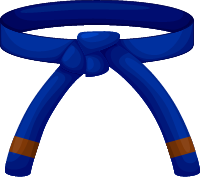
 Blue Belt with Brown Tip Training Resources
Forms: Joong-Gun
Tae Kwon Do Forms (Hyung) help our students develop techniques, improve their balance and coordination, and enhance their mental focus. Forms also serve as a way to preserve and pass down the traditional skills and movements of Tae Kwon Do.
The new form Blue Belts with Brown Tip learn is called Joong-Gun. The form is named for Patriot Ahn Joong-Gun, who assassinated the first Japanese Governor General of Korea. The form has 32 movements that represent Ahn’s age when he was executed at Lui-Shung Prison in 1910. Master Penny Duggan demonstrates Joong-Gun form in the video below.
In addition to Joong-Gun, practice Dan-Gun form (Yellow Belt) backwards. Master Penny demonstrates Dan-Gun form backwards in the video below [starts about 3:50].
Hand and Foot Techniques
Master Penny Duggan demonstrates hand / foot combinations. Use this as a daily workout tool for at-home training to practice your Tae Kwon Do mechanics. The new techniques to focus on practicing as a Blue Belt with Brown Tip required for testing for Brown Belt include:
- Hand Techniques:
- Offensive: Twin high punch, Twin upset punch, Upper elbow strike
- Defensive: Reverse knifehand block, Lifting palm block, High X-block, Pressing pressure block, and Staff block
In these videos, Master Penny Duggan takes students through the Tae Kwon Do Kicks, Basic to Advanced and Kicking Combinations. Use these videos to reinforce the kicks learned as lower belts and practice the new kick combinations.
The second video demonstrates the defensive hand techniques and blocks learned in the Tae Kwon Do forms. Students should focus on practicing the techniques used in the form Joong-Gun as well as reinforce and refine blocks learned as a lower belts.
The third video demonstrates the offensive hand techniques learned in the Tae Kwon Do forms. Students should focus on practicing the techniques used in the form Joong-Gun, as well as reinforce and refine strikes and punches learned as lower belts.
Terminology
This audio track provides the basic terminology for Blue Belts with Brown Tips to learn for consideration of promotion to Brown Belt.
- Counting from 60 to 80 in Korean
- Intermediate vocabulary
Self Defense
When testing for the next belt level, students are required to demonstrate three self defense techniques in a row. For Blue Belts with Brown Tip, it’s recommended to practice defense against spontaneous attacks, and a full nelson. Master Penny Duggan demonstrates Street Smart Self Defense in the following video.
Board Breaking
Intermediate and advanced students are required to break boards for their promotion test. Youth are required to break one (1) board. Women are required to break two (2) boards. Men are required to break four (4) boards. Boards can be purchased from Master Penny Duggan at the Redeemer classes. Affiliate students, please check with your instructors.
Recommended board-breaking techniques at the Blue Belt with Brown Tip level include:
- One board – any hand or foot technique
- Two boards – elbow or palm strike (adults)
- Two boards – backside kick (adults)
- Two boards – front kick (adults)
Master Penny Duggan demonstrates stationary board breaking techniques in the following video.
One Step Sparring
One-step sparring is a controlled martial arts drill where two students (or a student and instructor) perform a pre-arranged attack and a single defensive counter. Each movement is practiced step-by-step, focusing on precision, timing, and proper technique rather than free sparring. The “attacker” steps forward and executes a middle punch. The “defender” then executes their defensive block and attack sequence. For promotion testing, students will need to execute six different intermediate-level techniques and have knowledge of and practice two-on-one (alternate attack) sparring.
Benefits:
- Builds strong fundamentals and correct technique
- Improves timing, distance, and coordination
- Develops confidence in self-defense situations
- Enhances focus, discipline, and reaction speed
- Provides a safe way to practice realistic scenarios
Tournament Sparring
Tournament sparring is a controlled, point-based competition format in Tae Kwon Do where two competitors face off using legal hand and foot techniques to score points on designated target areas, with emphasis on speed, control, timing, and proper technique rather than full contact.
How to prepare for tournament sparring:
- Sharpen fundamentals: Focus on clean, fast kicks (like turning kicks and side kicks), strong guarding and blocks, and proper fighting stances
- Improve timing and distance: Practice judging range and countering effectively during drills and light no-contact free sparring
- Build conditioning: Work on cardio, agility, and explosive movement for quick attacks and recovery
- Drill combinations: Use simple, effective defend / attack–counter sequences you can rely on under pressure
- Practice control: Train to stop techniques accurately on target to avoid penalties
- Know the rules: Understand scoring areas, fouls, and match structure to compete strategically
- Mental preparation: Stay calm, focused, and confident and try to visualize matches and reactions of your opponent
Master Penny Duggan demonstrates tournament strategies that can be used in sparring to help score points at tournaments. Try these techniques in the free sparring sessions at class.
The Journey
A student’s Tae Kwon Do journey to Black Belt is enhanced by participating in Kim’s Tae Kwon Do Center’s camps, tournaments, and seminars. Students are encouraged to attend the following events to enhance their training with focused instruction.
- Attend a Kim’s Tae Kwon Do Winter or Summer Camp
- Attend a Kim’s Tae Kwon Do Tournament
- Attend monthly Tae Kwon Do Journey Seminars
Additional Training Tips
These videos and more are found on the Kim’s Tae Kwon Do Center’s YouTube Channel.